
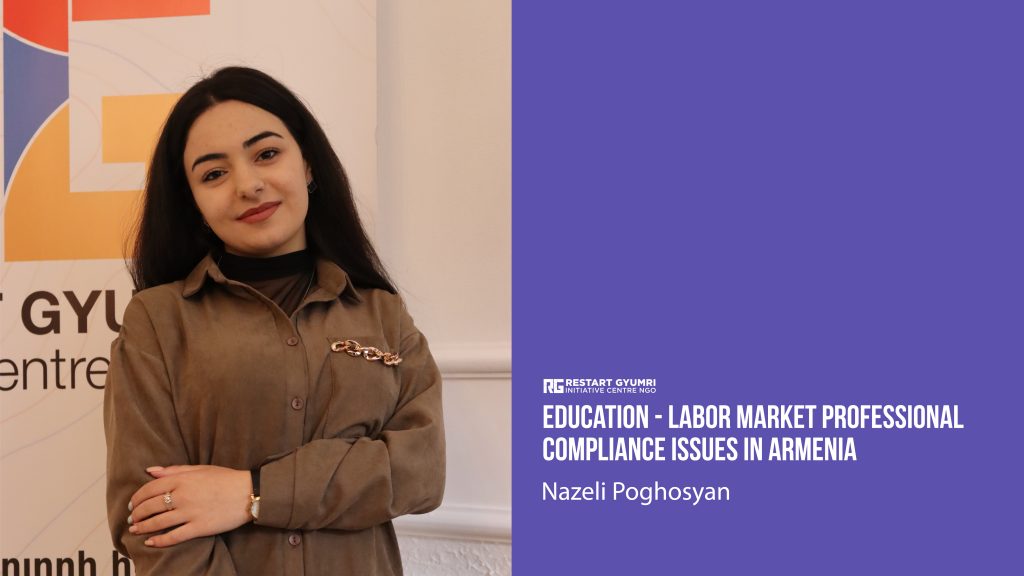
This article focuses on the issues of higher education’s inter-labor market compliance, student employment, labor market problems, and factors influencing unemployment. The article singled out as the most qualitative analysis of the urgent issues within the subject of research, which exists in the higher education system.
Keywords. State education policy, labor market, unemployment, employer, labor force.
In the 21st century, more than ever, the sustainable development of the state and the overcoming of the problems faced by that process are conditioned by the progressive development of the state’s education sector and the level of education of the society. Education is seen as a fundamental component of ensuring the viability of society, and state education policy is a key element of a unified state policy to ensure national security. Among the priorities in the state development policy of the Republic of Armenia, education continues to be a national value, one of the key factors ensuring the socio-economic progress of the country.
Education is a process of education and upbringing in the interests of the individual, society, and the state, which is aimed at preserving knowledge and passing it on to future generations. Education has always had a place and a role. Times have changed, the quality of education has improved, and consequently, its role has increased even more.
In our time it is impossible to imagine life without education.
Education has a strong positive impact on society and humanity in general.
Education becomes a means, a bridge between the past and the future, through which the high moral, scientific, aesthetic values and rich life experience created by the past are transmitted.
Through education, a person improves and strives for perfection. The great thinkers of all time have considered education to be the main wealth of man.
Given the unprecedented rapid growth of scientific and technical information, there is a need for learners to assimilate, accumulate and analyze information. Therefore, education must first ensure the acquisition of knowledge, as well as the analysis of acquired knowledge and its application by students in practice. The ability to think creatively, to orient oneself independently in information, which becomes more relevant in the conditions of introduction of modern technologies in the educational system, is very important for the learner. However, along with the reforms in the field of education, there are a number of problems, the possible solutions of which will lead to further improvement of the quality of the higher education system. The emergence of these problems is “objective” and subjective.
It is obvious that without overcoming systemic problems, it is impossible to ensure the competitiveness of the education system, both in terms of ensuring self-realization opportunities in Armenia and integration into the European environment.
At present, the sphere of higher education in the Republic of Armenia is regulated by the laws of the Republic of Armenia “On Education”, “On Higher Postgraduate Professional Education”.
The RA Law on Education defines the legislation of the Republic of Armenia on education, the problems of the legislation in the field of education, the basic concepts, the state policy in the field of education, the principles of that policy. The law also defines the state guarantees of educational law, the education system, the general requirements for state educational standards, curricula, the content of education, as well as the principles of organizing the educational process. The law defines the general requirements for admission to an educational institution, including a higher education institution, the implementation of professional education programs, in particular higher education, postgraduate professional education, and additional education. The law enshrines the autonomy of higher education institutions and academic freedoms. From the point of view of the management of the education sphere, Article 36 of the Law, which defines the competence of the Government of the Republic of Armenia in the field of education, is possible. According to the current law, the Government of the Republic of Armenia:
Ensures the implementation of the state educational policy;
Approves the procedure for the development of state educational standards;
Defines the national qualifications framework; approves the general characteristics of education qualification degrees;
Approves the list of taught professions;
Approves general education, initial professional (vocational), secondary professional, higher professional state order for education,
Approves the model charters of state educational institutions;
Approves the forms of graduation documents of state design;
Defines the procedure for organizing and implementing additional educational programs;
Defines the procedure for evaluation and recognition of non-formal information learning results;
Exercise other powers defined by law.
Article 37 of the law defines the powers of the authorized body of state education management. According to which the authorized state body of education management:
Develops the state program for the development of education, the procedure for establishing and approving state educational standards;
Exercises control over the application of the state education program և state educational standards;
Ensures the development and publication of exemplary general education programs, curricula, subject programs, textbooks, educational manuals;
Carries out the licensing of educational institutions;
Develops model charters of state educational institutions;
Approves the procedure for qualification of pedagogical-managerial staff of educational institutions;
Approves the qualification characteristics according to specialties, educational degrees;
Compiles the lists of educational professions;
Develops the state order of general education, preliminary professional (vocational), secondary professional, higher professional educational institutions;
Approves the rules for admission to state-accredited non-state preliminary professional (vocational), secondary, and higher educational institutions, supervises their implementation;
Approves the procedure for the transfer and final examination of the knowledge of the students of educational institutions;
Approves the honorary titles և titles awarded by the scientific councils of accredited higher education institutions in accordance with the established procedure;
Develops the forms of graduation documents of the state sample for all levels of education.
Defines the procedure for determining and recognizing the equivalence of educational documents of foreign countries;
Ensures the formation, implementation, and control of development programs of state educational institutions;
Gives consent to the appointment and dismissal of the heads of regional education departments, communities (divisions), directors of general education institutions, in accordance with the procedure established by the Government of the Republic of Armenia;
Gives consent to the reorganization or liquidation of educational institutions by the relevant state authorized body;
Executes other authorities defined by the laws of the Republic of Armenia and government decisions.
The RA Law on Education also defines the basic principles of licensing of educational activities, state accreditation, relations related to the financing of educational institutions, including higher education institutions, and their ownership.
The principles of management in the field of higher education are defined by the RA laws “On Higher, Postgraduate Professional Education”. In particular, within the framework of management functions, the principles of the state policy of higher and postgraduate professional education are mentioned:
Ensuring and protecting the right of a person and citizen to receive higher and postgraduate professional education;
Access to higher and postgraduate professional education;
Continuity, sequence, and continuity of the educational process;
Competitiveness, transparency, and publicity.
Ensuring the comparability of the qualifications of the postgraduate education of the Republic of Armenia in other European and foreign countries and Ensuring the recognition of diplomas and their inserts;
Promoting the international mobility of students;
Academic freedoms of higher education institutions and Promoting and developing autonomy;
For the Armenian Diaspora, as well as the training of specialists for the development of Armenology, the raising of qualifications.
The law defines the issues related to the state policy in the field of higher and postgraduate professional education in the Republic of Armenia:
Ensuring the quality of higher և postgraduate education.
Supporting the training of specialists in areas of primary importance to the state, such as in border or highland areas;
Promoting the development of international scientific-educational cooperation and its integration;
Development of higher postgraduate professional education system increasing competitiveness in the international arena;
Introduction of international (European) accreditation standards for the quality of education in the system of higher and postgraduate professional education of the Republic of Armenia.
Ensuring the equality of accredited higher education institutions, regardless of ownership.
From the point of view of the management of the field of higher, postgraduate professional education, the following competencies are defined by the Government of the Republic of Armenia:
Creation, reorganization, and liquidation of state higher educational institutions in the manner prescribed by the legislation of the Republic of Armenia;
Approval of the procedure for setting state educational standards for higher and postgraduate professional education;
Approval of the procedure for state accreditation of higher education institutions and organizations implementing postgraduate education;
Approval of the licensing procedure for educational programs;
Approval of the list of higher and postgraduate professional education specialties, their teaching forms, qualifications given in accordance with the main educational programs;
Approves the list of professions taught by the diploma specialist’s educational program;
Approval of the procedure for admission of applicants to higher education institutions a unified system of knowledge assessment;
Defining the order of mobility of students in higher educational institutions.
Approval of the procedure for admission to postgraduate studies, postgraduate studies, doctoral students, applicants;
Approval of the model horse contract concluded with the postgraduate applicants;
Defining the procedure for employment of specialists who have graduated from postgraduate education in educational or scientific organizations carrying out postgraduate education within the framework of state order.
Approval of lists of general characteristics of higher և postgraduate professional education professions, their teaching methods, qualifications given in accordance with them, implementation of changes and additions;
Distance approval of the lists of professions that are not allowed to be taught through externship (extern) training;
Approval of the procedure for providing financial resources, including the procedures for reimbursing tuition fees, establishing scholarships, receiving educational loans, and financing educational foundations;
Registration of charters of state non-commercial organizations, making additions and changes in them;
Determining the maximum amount of tuition fees according to educational degrees accreditation results.
A simple analysis of the mentioned laws, especially the powers vested in the state body authorized by the Government of the Republic of Armenia, shows that in terms of management efficiency, the autonomy of higher education institutions, there are a number of problems – internal contradictions, which cause difficulties in coordinating the sector.
The Armenian article is by the link below – https://www.rgnews.am/?p=3442
The article was written by Nazeli Poghosyan, a participant in the first round of the “Article Contest” organized by the Restart Gyumri Initiatives Center NGO.


More Stories
«Արվեստի և ժողովրդավարության» Երիտասարդ ստեղծագործողների բաց մրցույթ
ԿԱՐՃԱՄԵՏՐԱԺ ՎԻԴԵՈՀՈԼՈՎԱԿՆԵՐԻ ՄՐՑՈՒՅԹ
ՈՒՍՈՒՄՆԱՍԻՐՈՒԹՅՈՒՆ. «ՀՀ ՄԱՐԶԱՅԻՆ ԵՐԻՏԱՍԱՐԴՈՒԹՅԱՆ ՔԱՂԱՔԱԿԱՆ ՄԱՍՆԱԿՑՈՒԹՅԱՆ ՑԱԾՐ ՄԱԿԱՐԴԱԿԻ ՊԱՏՃԱՌՆԵՐԸ»